
Wood County Parole Versus Probation
Probation and parole are not two names for the same Wood County release status. The Wood County Court of Common Pleas may place a person on community control instead of, or after, a local jail term. Its Adult Probation department also supports pretrial release and bond programs with court-set reporting rules. The court journal is the key record because it states the term, conditions, later violations, and discharge. A direct release from Wood County Jail does not by itself create state parole.
Parole and post-release control follow certain Ohio prison sentences. The Ohio Department of Rehabilitation and Correction, or ODRC, records that supervision, and its Adult Parole Authority, or APA, provides field services. Parole is a release framework for an eligible sentence. Post-release control is a statutory term of supervision tied to qualifying prison sentences. Neither should be inferred from a blank Sheriff roster.
| Supervision | Who imposes it | Best Wood County check |
|---|---|---|
| Probation or community control | Sentencing court | Common Pleas docket and Adult Probation |
| Parole | Ohio parole authority under the sentence | ODRC detail, Board record, and APA office |
| Post-release control | Ohio law and the prison sentence | ODRC status, supervision fields, and APA |
| Pretrial release | Court before final disposition | Bond order, docket, and pretrial program |
The record names the path. Do not choose an office based only on where the person now lives.
- Community control
- Ohio court supervision often called probation.
- Parole
- Conditional release under parole authority for an eligible sentence.
- Post-release control
- Supervision after prison for a qualifying Ohio sentence.
- Discharge
- The formal end of a sentence or supervision term, not merely release from a cell.
Verify Wood County Release Supervision
Start with the case that caused custody. A Wood County felony docket can show community control, prison commitment, a revocation, or a later termination entry. If the person entered ODRC custody, use the state offender record to separate incarceration, APA supervision, released status, and Violators at Large. Match identity and the Wood County case before relying on any status.
- Find the sentencing court and case number. Read the signed sentence and later journal entries in date order.
- For county probation, confirm the community-control term with Wood County Adult Probation. Ask whether the public docket has the latest discharge or violation entry.
- For a prison sentence, open the ODRC Offender Search. Match name, ODRC number, offense, docket, judge, and County of Commitment.
- Read Status, Supervision Start Date, Period of Supervision, APA Offices, and Conditions when those fields appear. Copy the labels as displayed.
- Use the named APA office from the person's detail. The office shown is safer than guessing from a Wood County address.
- Recheck current custody separately if a violation or warrant is shown. Supervision status does not prove where the person is now.
ODRC's Residential County field applies to APA Supervision and Violators at Large. It reflects a last-recorded address and may lag. County of Commitment identifies the sentencing source, not the present home. Those two filters serve different tasks.
Note: A Wood County jail departure and the formal start or end of supervision can occur on different dates.
Wood County Probation Contact
Wood County Common Pleas is the local source for felony probation and pretrial-release routing. Its public CourtView docket can establish the court's order, but a delay may occur between an action and online posting. The clerk also warns that some older records are not available online. Contact the court when a person-level record appears incomplete, then ask Adult Probation only for information it may lawfully provide.
Wood County Court of Common Pleas
1 Courthouse Square
Bowling Green, OH 43402
419-354-9042
Monday through Friday, 8:30 a.m. to 4:30 p.m.
State supervision does not have one safe, fixed local contact for every Wood County resident. The public ODRC record may name an APA Office. Specialized assignments and changes can occur, so consult the current APA field-services directory after reading that label. ORC 5149.02 creates the APA structure, while ORC 5149.06 describes field services. Those statutes define the agency role, not a person's current status.
Wood County Supervision Violations
Conditions come from the actual court order or state supervision record. They may require reporting and compliance with limits set for that person. ODRC publishes general Conditions of Supervision, but the general document cannot replace the individual order. A violation allegation may lead to court action, an APA response, a warrant, or a custody change. It does not prove that the person has already been returned to jail.
ODRC's Violators at Large list is a distinct public status route. It is an alleged absconder or APA-status list, not a live address finder. ODRC publishes Fugitive.Val@odrc.state.oh.us and 614-752-1114 for information. The public should not approach a listed person. Current warrant and custody confirmation belongs to law enforcement.
The official ODRC Violators at Large page is shown in the captured source below.
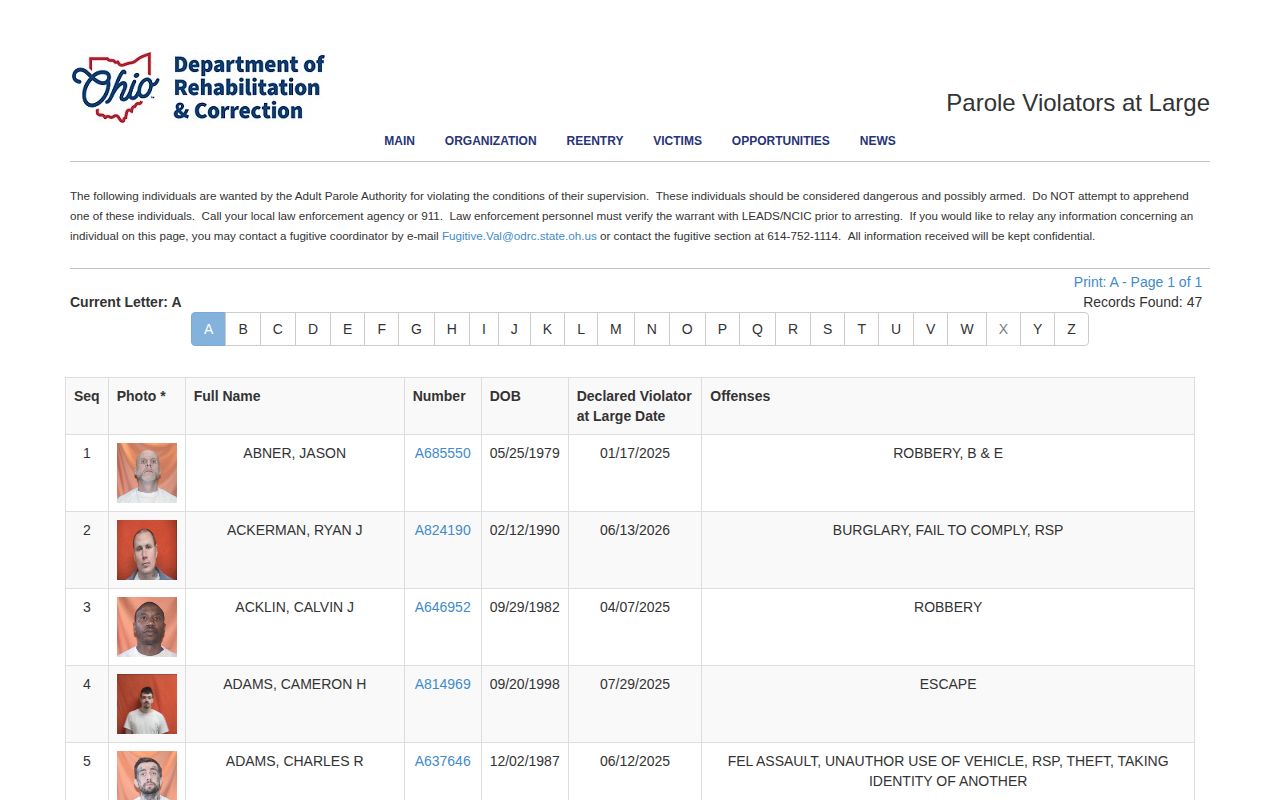
Use it only to read the published APA status and contact route, then verify present custody through the proper agency.
An active APA record does show that institutional custody ended at an earlier point. Still, it cannot rule out a new Wood County, state, federal, or immigration detention. Check the relevant custodian when current location matters. Ohio VINE can report custody changes from participating jails and ODRC, but the Attorney General warns against relying on VINE alone.
Note: An absconder label describes alleged supervision noncompliance, while a jail roster answers the separate question of present county custody.
Wood County Supervision Discharge
Release and discharge are different milestones. Physical release ends a specific period of confinement. Discharge ends the supervision or sentence component identified by the controlling authority. For Wood County probation, look for a journalized termination or discharge in the sentencing court. For APA supervision, read the ODRC record and ask the named office to confirm the status when the public fields are not clear.
A blank current-jail result cannot establish discharge. It only means the person did not return in the Sheriff's current P2C inquiry at that moment. Likewise, a historical ODRC release date may mark departure from an institution while parole or post-release control continues. The broader Wood County released inmate search and records path explains how Jail Records and the controlling court confirm the custody event itself.
Sealing and expungement can also change public access. Under Ohio Revised Code Chapter 2953, final discharge can control statutory timing, and it may occur later than release from jail. Do not calculate it from roster disappearance. Use the court's order and the current law for the specific case.
Wood County Reentry at NWCCC
NorthWest Community Corrections Center creates a local completion route that differs from both jail release and state parole. NWCCC is a secure community-based correctional facility serving a five-county area. County records describe case managers working on reentry plans and referrals while coordinating with probation departments, courts, and providers. A resident's completion is therefore linked to the placement and sentencing structure.
The Sheriff's P2C catalog is the wrong source for this event. NWCCC is not a second Wood County jail, and completion does not become a Sheriff's released-inmate entry. Check the sentencing court's journal, the supervising probation department, and the county planning record together. NWCCC is at 1740 East Gypsy Lane Road in Bowling Green and can be reached at 419-354-7444 for facility routing.
This local distinction matters when a name vanishes from one system or never appears there. A court may complete, terminate, modify, or transfer a community-corrections placement without creating a P2C event. The official county government guide and planning material support that multi-agency path.
Wood County Parole Hearing Records
A hearing date is not a projected or actual release date. ODRC's search includes a Next Parole Board Hearing Date field in six-digit year-and-month form. A person's detail may also show the review month and the latest hearing type and result. Search by the month, then open the individual detail and match it to the Wood County sentence.
The Ohio Parole Board records grants, denials, continuances, and other actions in its official minutes. A grant can include conditions or a future effective date, and later action may affect it. Ohio Administrative Code rules permit the Board to keep, accelerate, or rescind a projected release date in covered matters. Read the live result. Never convert eligibility or a scheduled review into proof of release.
Eligibility depends on the sentence and governing law. ORC 2967.13 covers specified parole-eligible life and indefinite sentences, but it supplies no single rule for all Ohio prisoners. Common Pleas establishes the sentence, ODRC maintains the correctional detail, the Board documents its action, and APA confirms supervision after release.
Note: A parole grant may set a later effective date, so verify the current ODRC status before reporting institutional release.