
Wood County Projected Versus Actual
A projected date is a calculated future point. An actual release is a completed custody event recorded by the jail or prison. Wood County Jail says it can provide an anticipated release date when one applies, but it publishes no public calculator or guarantee. A pretrial detainee may leave after bond, dismissal, or another court order. Until the court acts and the jail clears the release, there may be no set day at all.
A sentenced county inmate is different. The signed sentencing entry, credit for time already held, and the Sheriff's calculation shape the anticipated date. State-prison dates belong to ODRC, not to the county jail formula. A Wood County P2C result also cannot answer the projected-date question after release because the Sheriff says a released arrestee no longer returns in current inquiry.
The same distinction applies to parole. A board hearing month or eligibility date is not an exit date. A grant may have a future effective date and can be subject to later action.
Find a Wood County Release Date
First identify which agency has custody. A direct Wood County jail sentence and an Ohio prison sentence use different records. A transfer can remove a person from P2C without releasing that person to the community. Use the court docket to connect the custody path and then read the record held by the actual custodian.
- Obtain the signed sentencing entry. Confirm the case, term, jail credit, and whether counts run at the same time or one after another.
- For Wood County Jail, call Jail Records at 419-354-7744 option 1. The official jail page says an anticipated date is provided when applicable; ask whether another hold affects departure.
- For an Ohio prison term, open the ODRC Offender Search. Match name, ODRC number, County of Commitment, offense, docket, and judge.
- Copy the exact prospective label and current Status. Compare it with parole, sentence, institution, and supervision detail rather than reading one date alone.
- Check the Wood County court journal for corrected entries, judicial release, revocation, or later orders that could affect the calculation.
- Contact the custodian when the public date conflicts with the signed order. Do not replace the official calculation with website arithmetic.
The Wood County released inmate lookup connects Jail Records, court, and receiving-agency routes when the custody type is unclear. A name-only match is not enough, especially when two records share similar names.
Note: A person awaiting trial may have no projected date because release still depends on a court-authorized event and hold review.
Ohio Earned Credit Rules
Ohio does not use one universal rule that every person serves exactly eighty-five percent. Current ORC 2967.194 applies to qualifying confinement on or after April 4, 2024. Eligible people provisionally earn one or five days per month for productive participation and may receive up to five added days for a second qualifying activity. Specified program completions can yield ninety days or ten percent of the stated term, whichever is less. Ordinary aggregate program and activity credit is capped at fifteen percent of the stated term.
That cap explains the shorthand about serving eighty-five percent, but the phrase is not a safe Wood County release-date formula. Some offenses and terms are excluded. Credit is provisional, subject to review, and may be denied or withdrawn for rule violations. Murder, aggravated murder, life without parole, specified sexual sentences, mandatory or nonreducible terms, and other listed cases do not fit the ordinary rule. Earlier confinement can fall under the prior statute.
The official earned-credit statute shows why the rule needs context. The Ohio earned-credit provision is visible in the captured official page below.
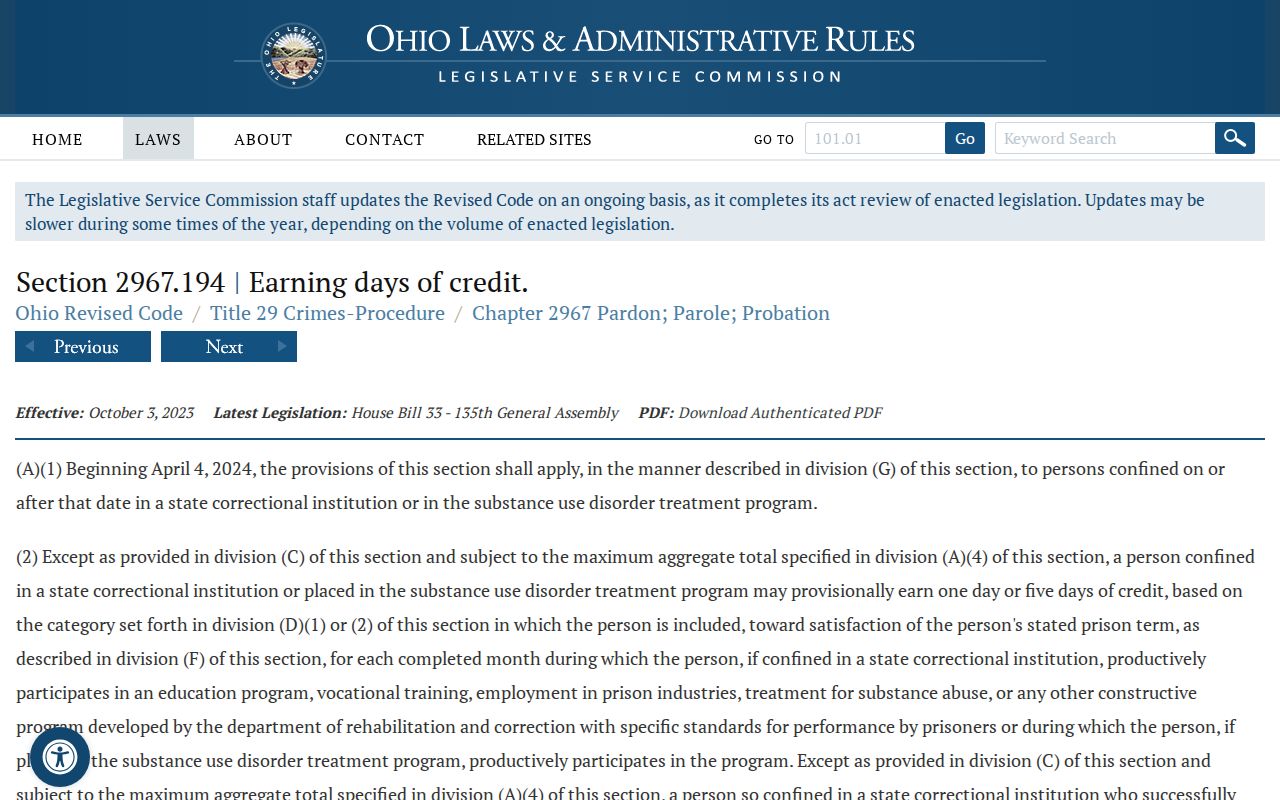
Read eligibility, exclusions, awards, and withdrawals before connecting credit to a person's live ODRC date.
Why Wood County Dates Change
A projected date can move when a new fact enters the official calculation. ODRC may receive a corrected entry, apply or withdraw earned credit, reconcile terms, or carry out a court or board action. A county jail may receive a release form but still need to check identity and other holds. No future date proves that every required step is complete.
| Factor | Possible effect | Record to check |
|---|---|---|
| Jail-time credit | Counts qualifying prior custody toward the term | Sentencing entry and ODRC calculation |
| Earned credit | May reduce an eligible term; loss or denial can move the date later | ODRC detail and ORC 2967.194 |
| Concurrent or consecutive terms | Changes how multiple counts or cases combine | Signed journal entries |
| Corrected court order | Can change credit, term, or legal authority | Latest journalized entry |
| Parole or Board action | May grant, continue, deny, accelerate, or rescind a release posture | Official Board result and ODRC record |
| Detainer or other hold | Can cause transfer or prevent community release | Custody chronology and receiving agency |
A federal BOP future date is also projected and may change during First Step Act recalculation. It has no role in an Ohio county-jail or ODRC sentence calculation.
Confirm Wood County Release Dates
For a county detainee, Jail Records confirms the physical custody event. The court order explains why release was authorized, but it normally does not certify the minute the person left. Perrysburg Municipal Court bond information illustrates that split: once bond is posted, it sends a release form to the jail, while the Sheriff remains responsible for physical release. Any other hold may change the outcome.
For a state prisoner, read ODRC Status with the date fields. Ohio VINE can add an agency-reported custody-change notice, but it should not stand alone. The Wood County VINELink Check explains how to match one person and register for an alert. After notice arrives, confirm with ODRC or the jail.
When exact proof is needed, request the release or transfer entry. Give the full name, useful identifiers, estimated admission and departure dates, and the facility. Ask whether the record shows date, time, release type, authority, any hold, and any receiving agency. Wood County publishes no special release-record fee or promised turnaround, so ask for an estimate and available electronic delivery.
Note: Court authority, an agency alert, and physical release are separate facts that may post at different times.
ODRC Wood County Date Fields
ODRC uses the combined label Expected Release Date/Parole Eligibility Date. Its definitions distinguish PRD, or projected release date, from POA, meaning parole on or after, which is the earliest release on APA supervision. The combined field may therefore represent an estimated exit or a point when parole consideration becomes possible. It does not show that departure took place.
The official ODRC field definitions identify the public labels used to read a Wood County prison record.
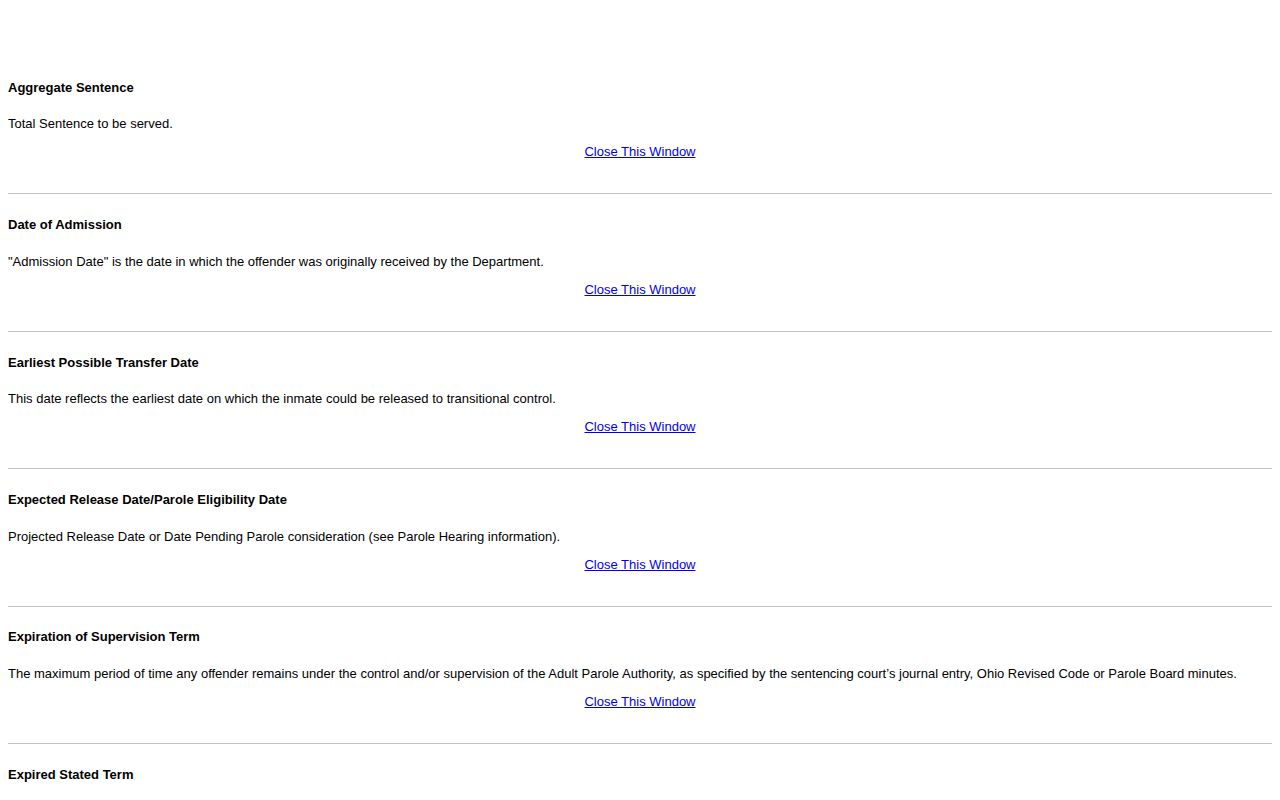
Compare the prospective label with Status, Parole or Release Detail, Supervision Start Date, and APA Office. A Released category can also be qualified by death, so it must not be translated automatically into community return.
The detail may also include effective sentence date, jail-time credit, counts, offense citations, aggregate sentence, committing county, docket, judge, and hearing information. ODRC warns that sentencing detail can be incomplete. Reconcile those fields with the Wood County Common Pleas chronology.
Search filters also need care. County of Commitment is the sentencing source, not the person’s current home. ODRC warns that when more than one committing county exists, the filter may use only the first county recorded. Residential County and ZIP apply to APA Supervision or Violators at Large and reflect a last-recorded address that may be delayed. For a Wood County sentence, start with County of Commitment, then match the docket and judge. For someone believed to be under supervision in Wood County, use the supervision status and residential filter only as leads. Neither filter changes the meaning of the expected-release field.
Next Parole Board Hearing Date is another search field, entered as a year and month. It locates a scheduled review, not an exit. The person’s detail may show the latest hearing type and result, but the official Board action must still be read for a grant, denial, continuance, effective timing, or later review. A projected release date recorded by the Board can be kept, accelerated, or rescinded under the applicable rules. This is why a single ODRC date should never be quoted without its label and status.
Wood County Sentence Computation
ORC 2967.191 requires credit for qualifying related pretrial, transport, juvenile, and prior ODRC confinement as the statute specifies. The signed sentence and correctional calculation must agree on the credit that applies. The official jail-credit page is captured below.
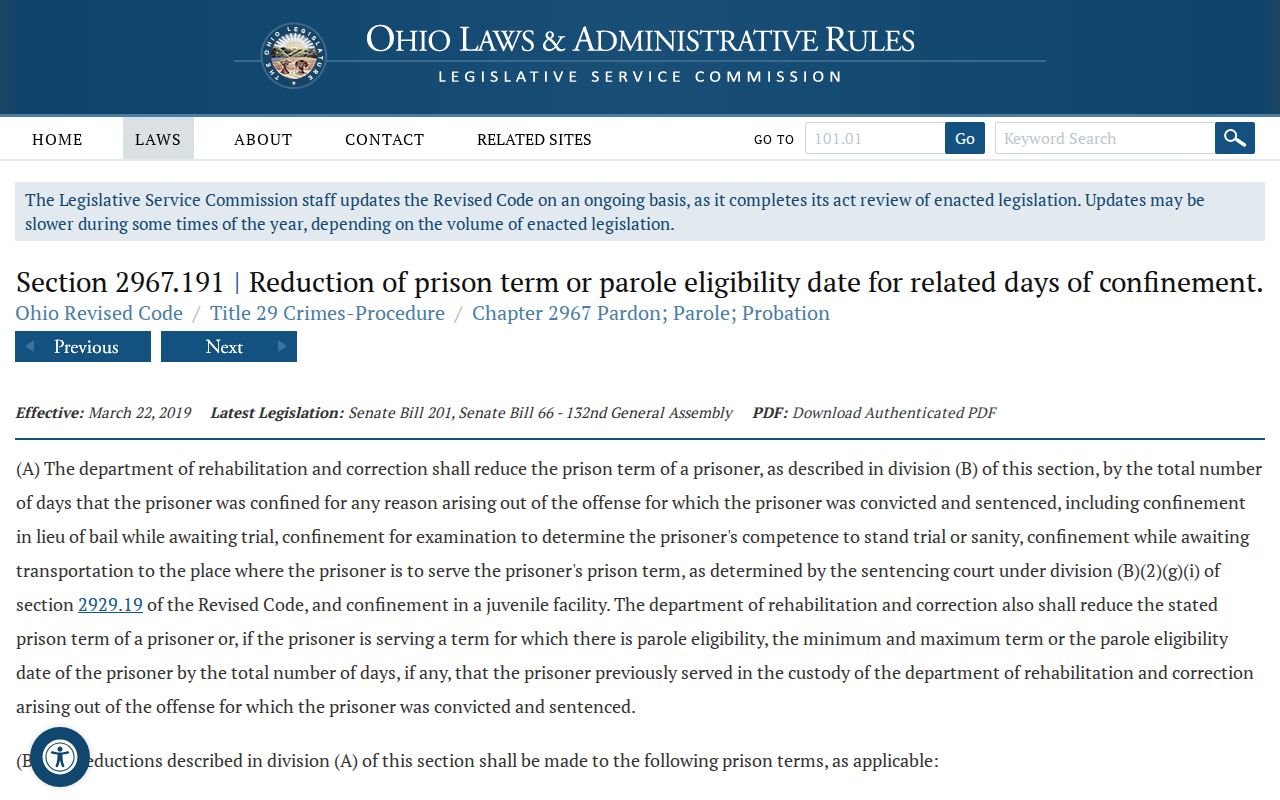
Credit can affect the computed term, but it does not clear an unrelated hold or prove release.
Reagan Tokes non-life felony indefinite terms add another layer. Under ORC 2967.271, release is presumed at the minimum or presumptive earned-early-release date, whichever comes first, but ODRC may rebut that presumption after a hearing and continue confinement up to the maximum. Judicial release under ORC 2929.20 is a court action, not automatic sentence math.
The official indefinite-term statute shows why a minimum is not always the actual day out.
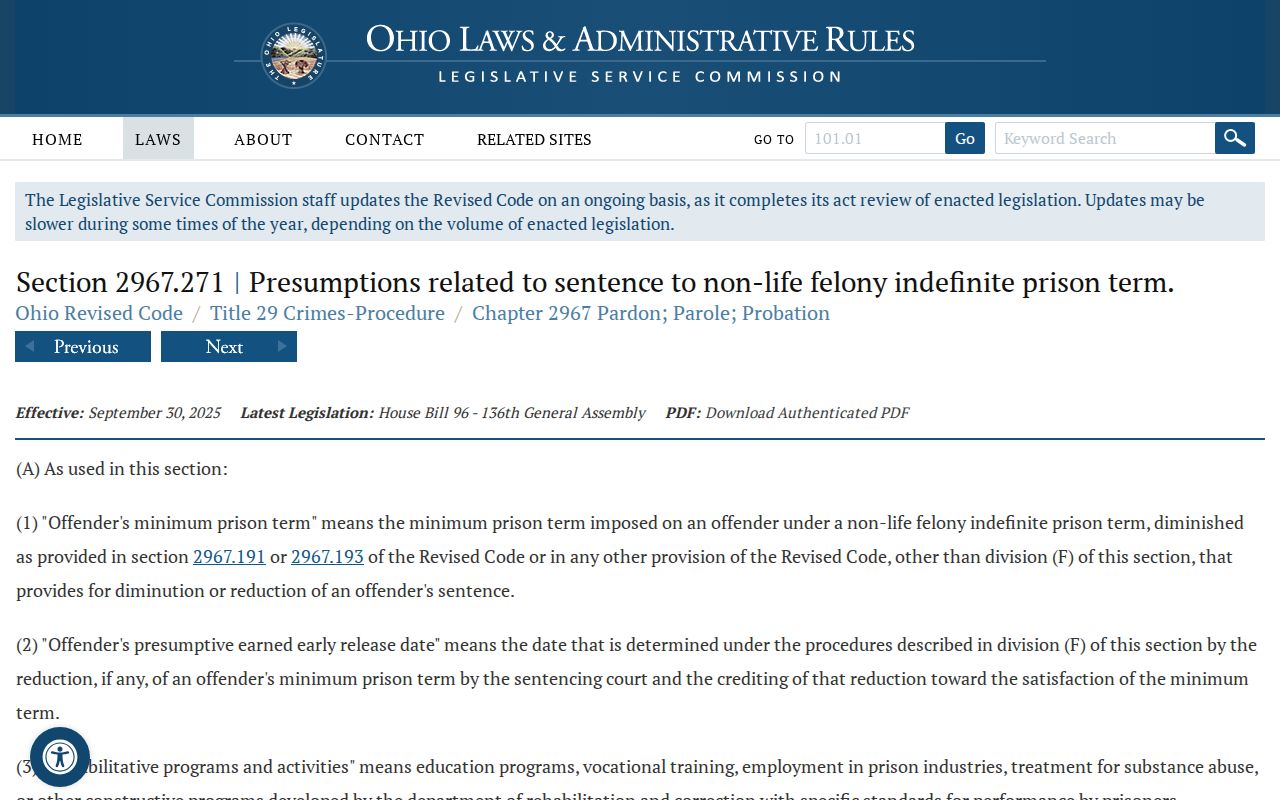
Read the journal entry, live ODRC status, and any hearing result together before describing an expected release.
Mandatory terms and parole-eligible components must be identified before earned credit is discussed. ORC 2967.13 governs parole eligibility for covered life and indefinite sentences, while post-release control under ORC 2967.28 is supervision after qualifying prison terms. Eligibility means the person may be considered at the legal point. It does not promise a grant. Post-release control begins after institutional release and is not a reduction formula. Combining these concepts into one percentage would erase the legal steps that actually control the Wood County record.
A detainer creates a different issue. The holding agency may finish its own term while another county, state, federal, or immigration authority takes custody. The first agency can record a release or transfer date even though there is no return to the community. When another hold is possible, ask for a custody chronology and the receiving agency. Then use that agency’s record for the next phase. The projected date answers when one term may end; it does not answer whether every sovereign has cleared the person.